Lung-RADS v2022
Reference Images
Overview
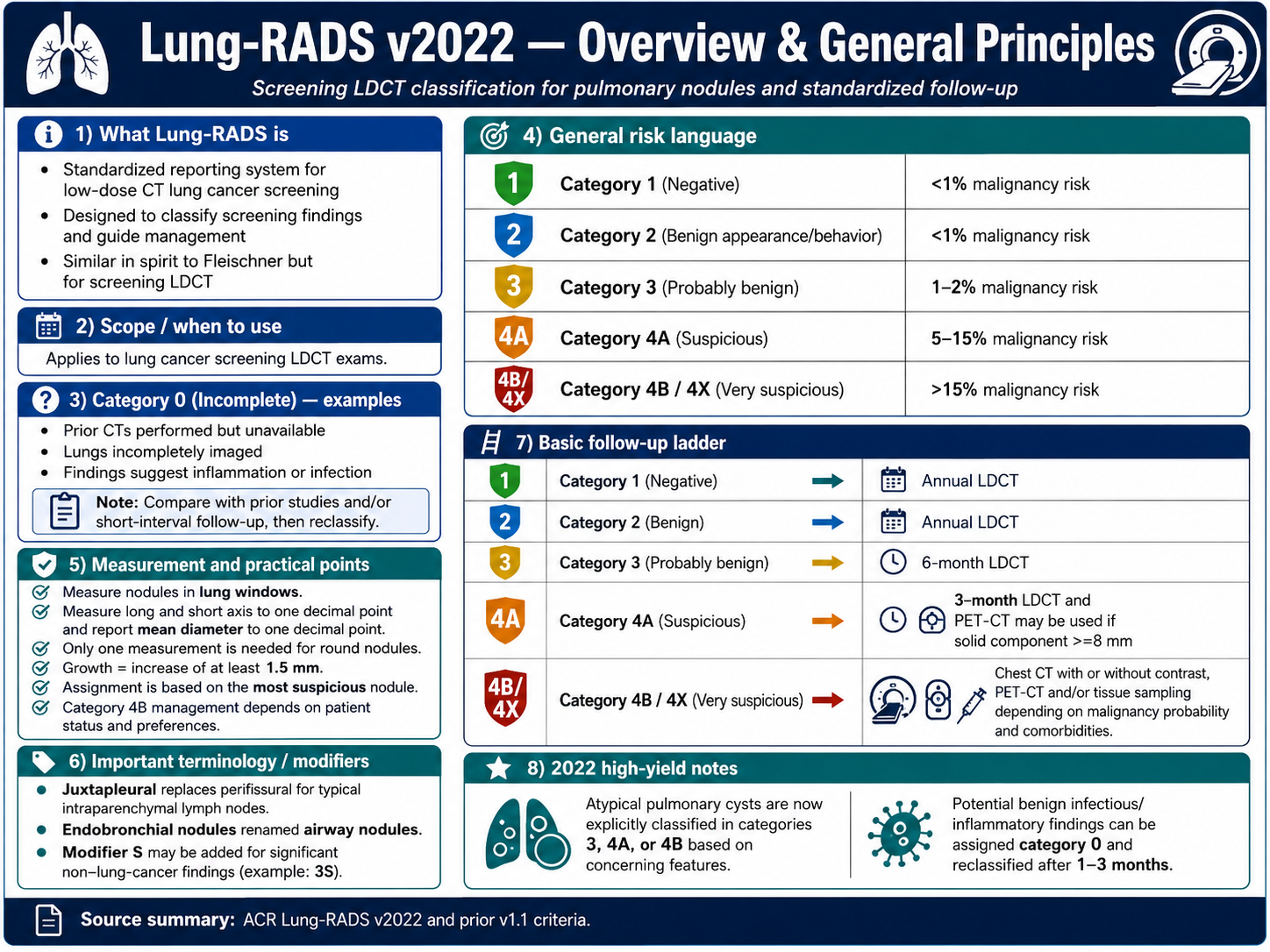
Use Lung-RADS when
Low-dose CT lung cancer screening exam. Use Fleischner or individualized management for incidental diagnostic CT nodules.
General principles
- Category assignment is based on the most suspicious nodule.
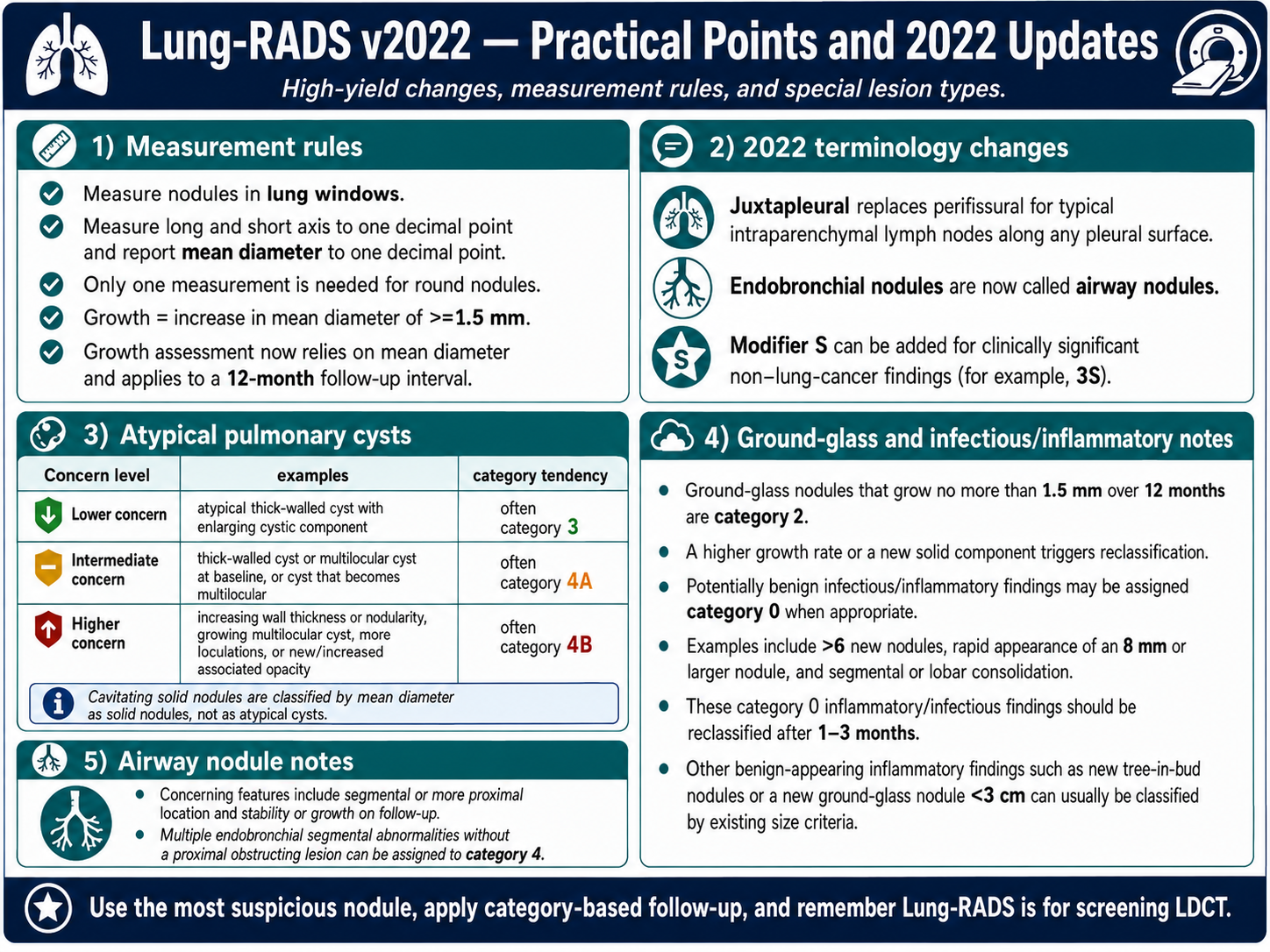
- Measure in lung windows; report mean diameter to one decimal point.
- Growth is an increase in mean diameter of at least 1.5 mm.
- Use modifier S for clinically significant non-lung-cancer findings when appropriate.
Basic follow-up ladder
- Categories 1 and 2: annual LDCT.
- Category 3: 6-month LDCT.
- Category 4A: 3-month LDCT; PET-CT may be useful when solid component is at least 8 mm.
- Categories 4B and 4X: diagnostic chest CT, PET-CT, and/or tissue sampling depending on context.
Categories 0-4A
0, 1, and 2
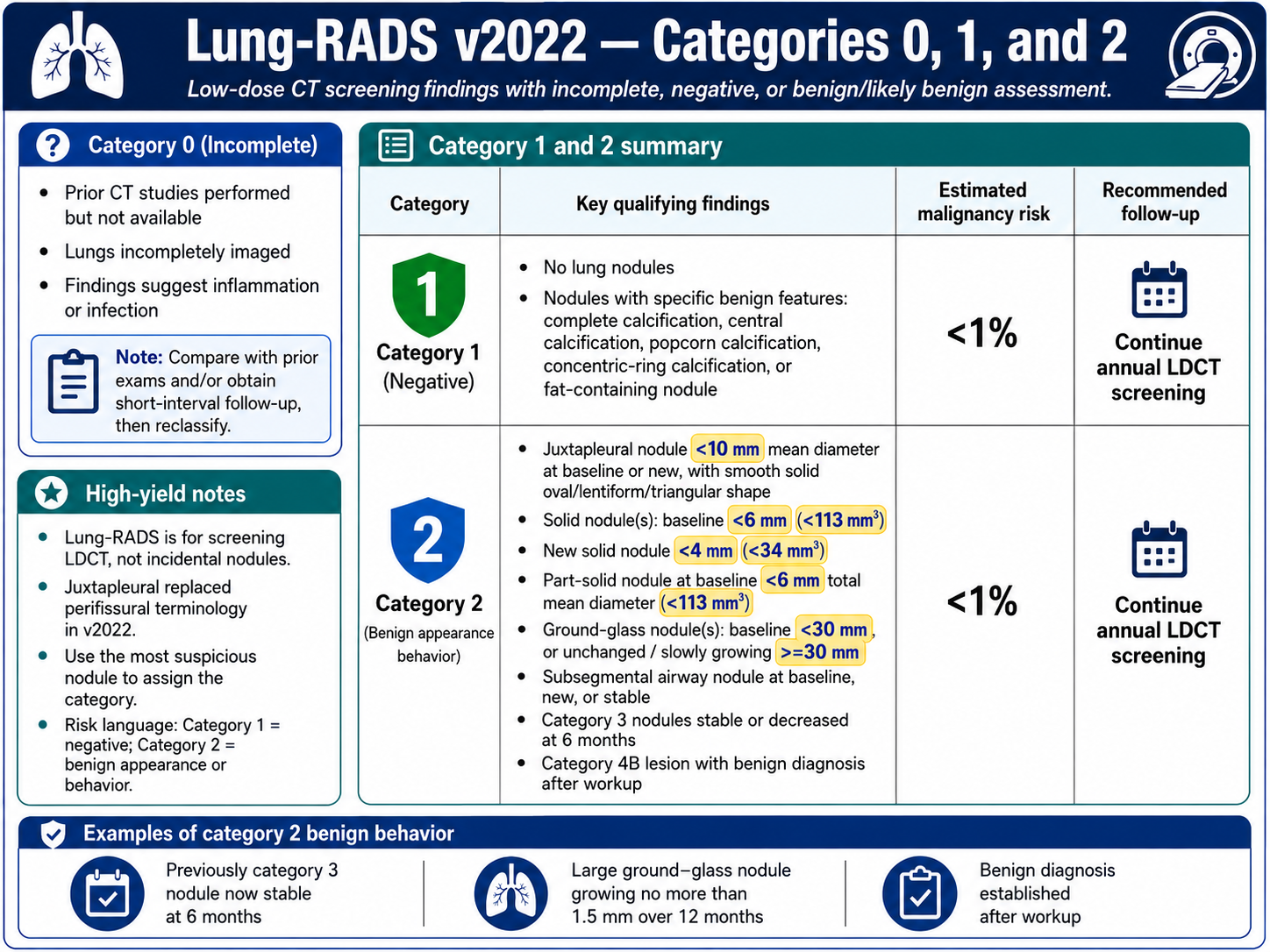
- Category 0: incomplete exam or findings needing comparison, additional imaging, or short-interval reassessment.
- Category 1: negative; annual LDCT.
- Category 2: benign appearance or behavior; annual LDCT.
- Juxtapleural nodules with benign morphology can be category 2 in v2022.
3 and 4A
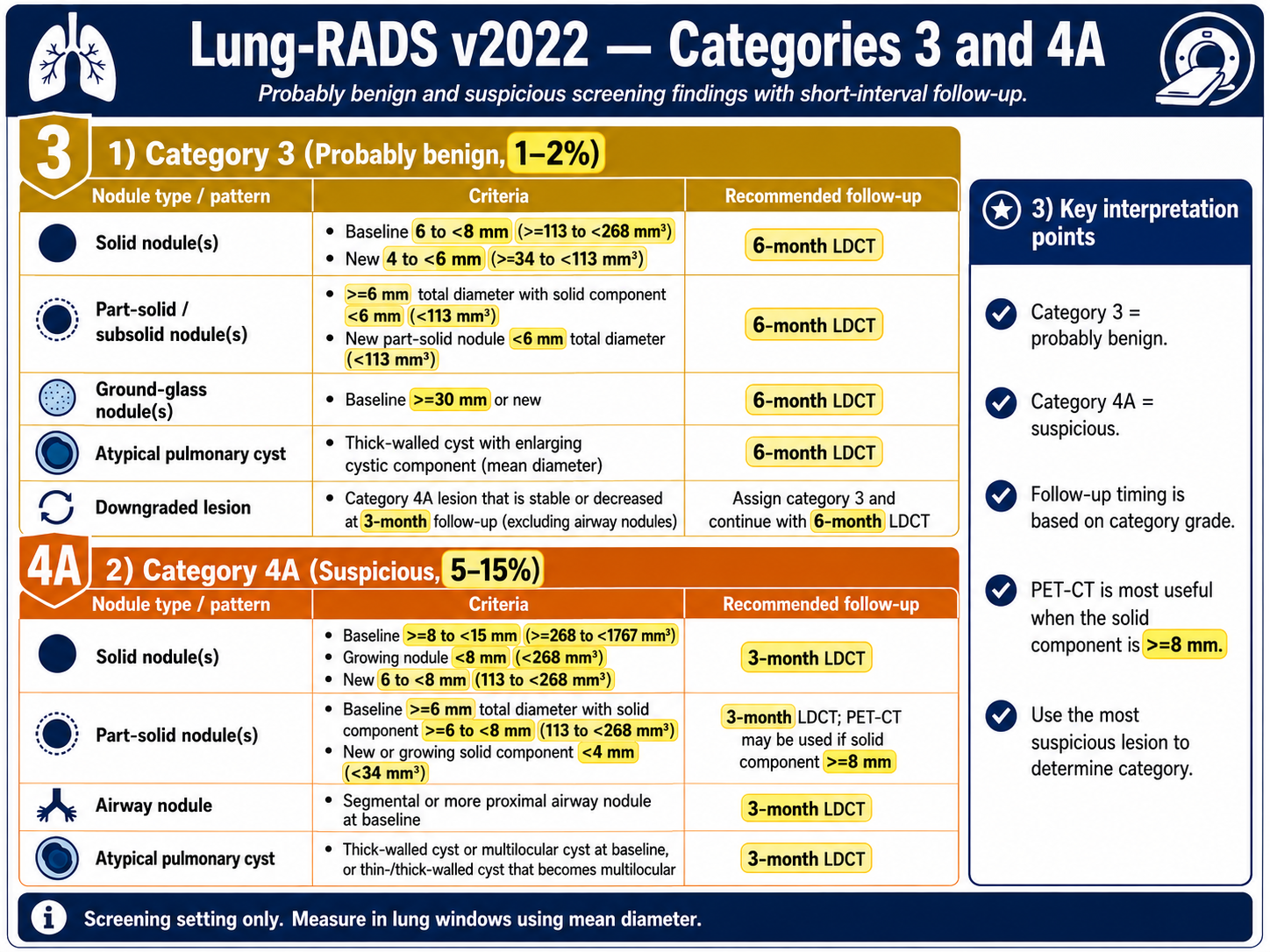
- Category 3: probably benign, estimated 1-2% malignancy risk; 6-month LDCT.
- Category 4A: suspicious, estimated 5-15% malignancy risk; 3-month LDCT.
- Category 4A lesions that are stable or decreased at 3-month follow-up can be assigned category 3 with 6-month LDCT.
- PET-CT is most useful when the solid component is at least 8 mm.
4B / 4X / Updates
Very suspicious categories
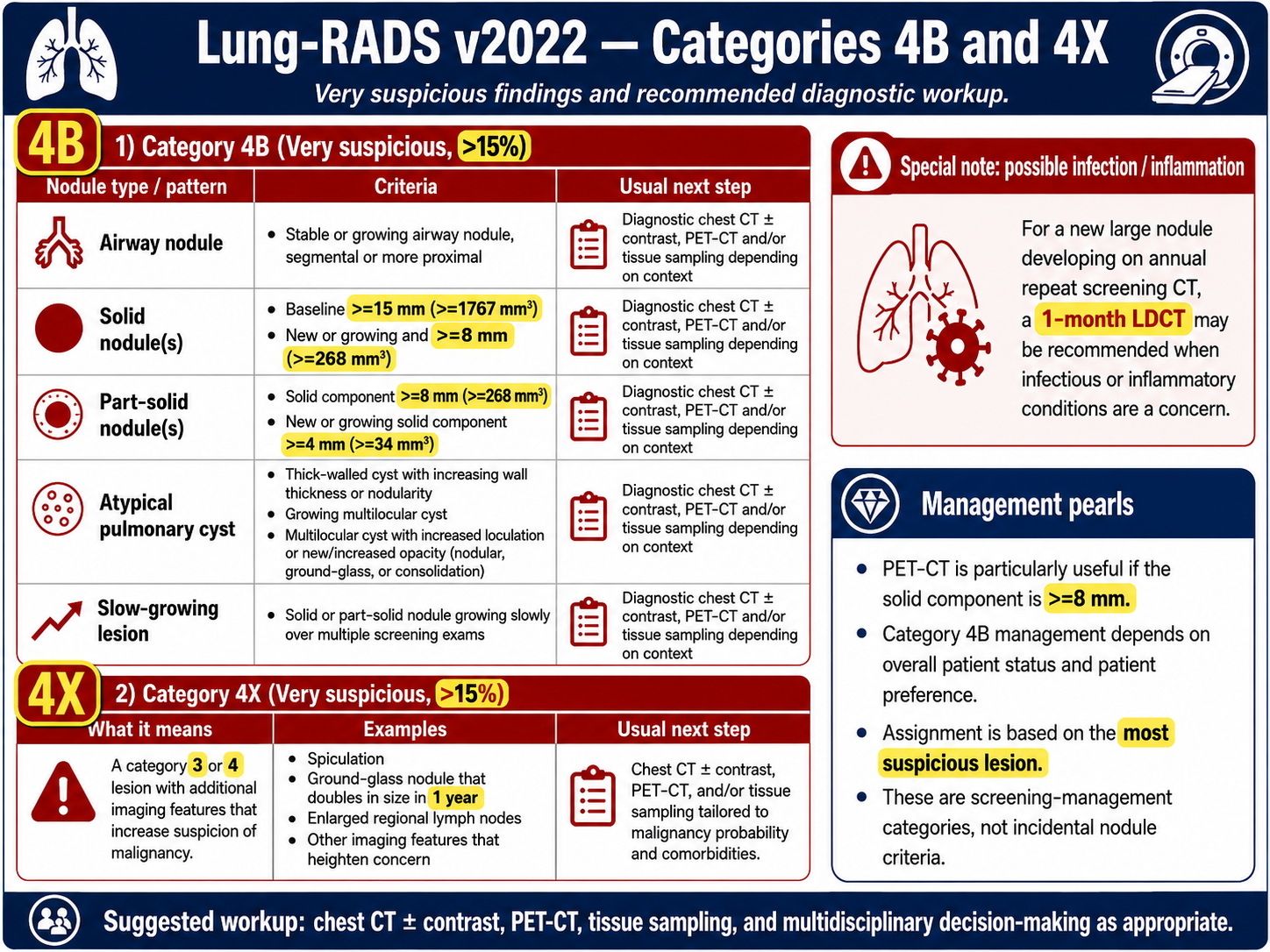
- Category 4B: very suspicious, estimated greater than 15% malignancy risk.
- Category 4X: category 3 or 4 lesion with additional imaging features that increase suspicion.
- Usual workup: diagnostic chest CT with or without contrast, PET-CT, and/or tissue sampling.
- If a new large nodule may be infectious or inflammatory, 1-month LDCT may be appropriate.
v2022 high-yield updates
- Juxtapleural replaces perifissural terminology for typical intraparenchymal lymph nodes along pleural surfaces.
- Endobronchial nodules are now called airway nodules.
- Atypical pulmonary cysts are explicitly classified as category 3, 4A, or 4B based on concerning features.
- Potential infectious or inflammatory findings may be assigned category 0 and reclassified after 1-3 months.
Sources
Practical Notes
Coding / Audit
Exam category
- Code each exam 0-4 based on the nodule with the highest degree of suspicion.
- Timing of follow-up is from the date of the exam being interpreted.
- Category 4A has a stepped pathway: if stable or decreased at 3-month follow-up, assign category 3 and continue with 6-month LDCT.
Audit definitions
- Negative screen: categories 1 and 2.
- Positive screen: categories 3 and 4.
- A negative screen does not mean the patient does not have lung cancer.
Measurement / Growth
Nodule measurement
- Measure long and short axis to one decimal point in mm; report mean diameter to one decimal point.
- Measurements may be made in any plane that best reflects true nodule size.
- If volume is used, report to the nearest whole number in mm3.
Thresholds and growth
- Size thresholds apply at first detection and when a nodule enlarges into a higher category.
- If a nodule crosses a new size threshold, reclassify by size even if it does not meet formal growth criteria.
- Growth: increase in mean diameter greater than 1.5 mm within a 12-month interval.
Special Patterns
Slow-growing nodules
- Slow-growing non-solid ground-glass nodules can remain category 2 until they meet another category criterion, such as developing a solid component.
- Slow-growing solid or part-solid nodules are suspicious and may be classified as category 4B even if they do not exceed the 12-month growth threshold.
- Slow-growing lesions may not be PET-avid; biopsy or surgical evaluation may be more appropriate when feasible.
Prior exams
- When prior CTs are pending, category 0 is temporary.
- Assign a new Lung-RADS category after comparison imaging becomes available.
Inflammation / Airway / Cysts
Infectious or inflammatory findings
- Category 0 with 1-3 month LDCT may be used for indeterminate infectious/inflammatory patterns.
- Examples include segmental or lobar consolidation, more than six new nodules, or a large new solid nodule appearing over a short interval.
- At follow-up, assign the new category based on the most suspicious nodule.
- Tree-in-bud nodules or new ground-glass nodules under 3 cm may often be categorized by existing size criteria instead of short-term follow-up.
Airway nodules
- Segmental or more proximal endotracheal/endobronchial abnormalities are category 4A.
- Subsegmental or multiple tubular endobronchial abnormalities often favor infection and may be category 0 or 2 if no obstructing nodule is present.
- Persistent segmental or proximal airway nodules at 3 months are upgraded to category 4B, typically prompting bronchoscopy or further clinical evaluation.
Atypical pulmonary cysts
- Thin-walled cysts with uniform wall thickness under 2 mm are benign and are not classified in Lung-RADS.
- Thick-walled or multilocular cysts are managed as atypical pulmonary cysts.
- Cavitary nodules are managed as solid nodules by total mean diameter.
- A cyst with an associated solid, part-solid, or ground-glass nodule is managed by the most concerning feature.
4B / 4X / Modifier S
Category 4B
- Management depends on clinical evaluation, comorbidities, patient preference, and malignancy probability.
- Risk tools such as the McWilliams/Brock model can help guide recommendations.
Category 4X
- 4X is a distinct category for category 3 or 4 nodules with additional imaging findings that increase suspicion.
- Examples include spiculation, lymphadenopathy, frank metastatic disease, or a ground-glass nodule that doubles in size in 1 year.
- X should not be used as a modifier.
S modifier
- Add S to categories 0-4 for clinically significant non-lung-cancer findings.
- Do not add S for findings already known and already being evaluated unless there is unexpected concerning change.
- Once lung cancer is diagnosed, additional imaging such as PET/CT is staging rather than screening.
Helpful Links
Risk and incidental findings
- McWilliams / Brock lung cancer risk calculators
- ACR Incidental Findings recommendations
- ACR LCS Incidental Findings Quick Reference Guide
Abbreviations
- LDCT = low-dose chest CT.
- GGN = ground-glass nodule.