HPV and EBV
HPV and EBV are both oncogenic viruses relevant to malignancies of the upper aerodigestive tract, but their associations are site-specific and not equivalent. HPV is an established causal factor for a major subset of oropharyngeal squamous cell carcinomas (OPSCC), whereas EBV is the defining viral etiologic factor for nasopharyngeal carcinoma (NPC), usually nonkeratinizing/undifferentiated rather than conventional keratinizing SCC.
Reference Images
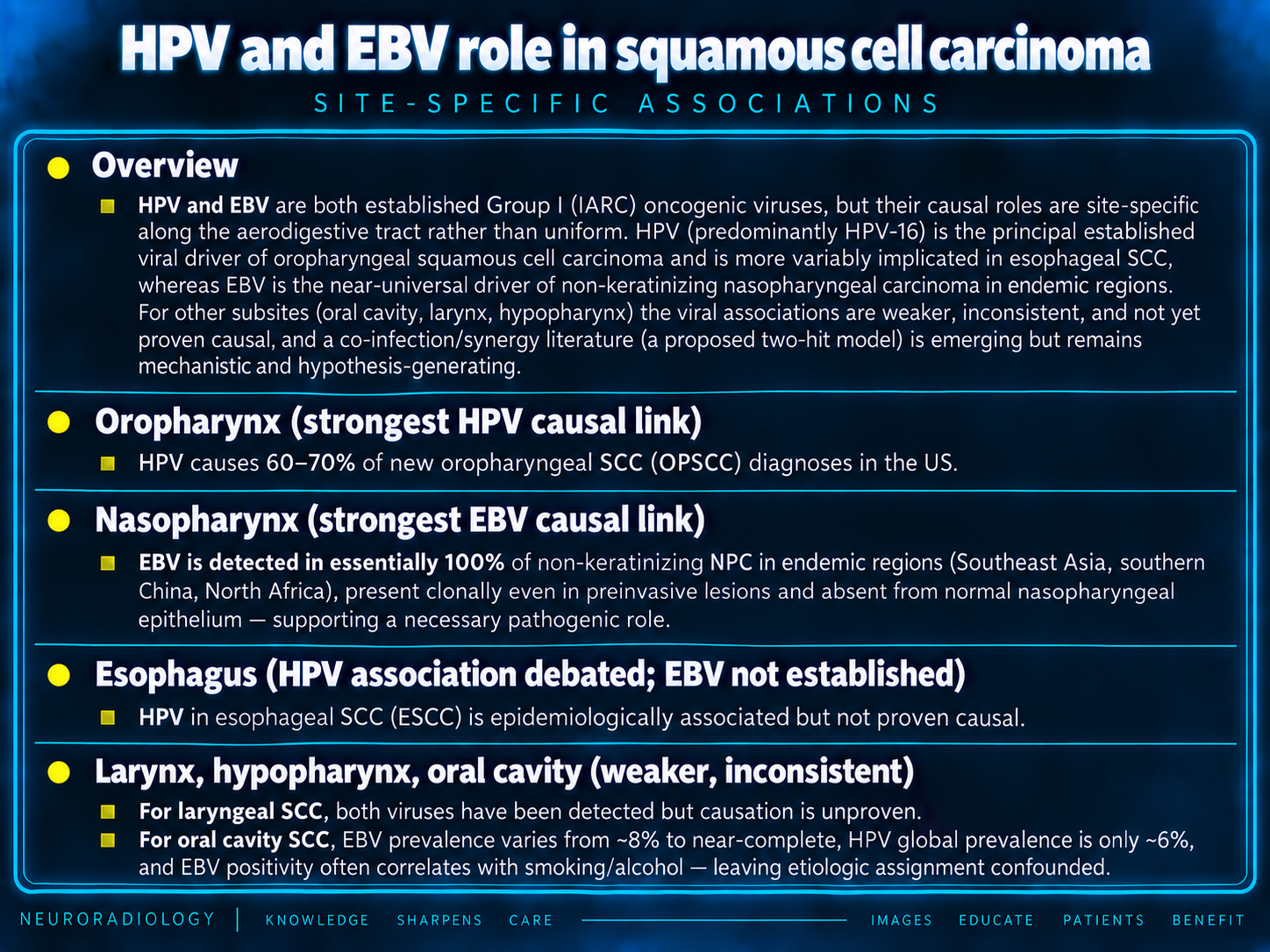
Source interpretation: The first graphic retains additional claims not independently documented in the supplied prose, including essentially universal EBV detection in endemic nonkeratinizing NPC, oral-cavity viral prevalence estimates, and a proposed co-infection/two-hit model. Its description of HPV in esophageal SCC as “epidemiologically associated” should be read alongside the prose’s more qualified description of investigational, heterogeneous evidence; causation is not established.
HPV · Oropharynx
Persistent high-risk HPV infection, especially HPV16, is an established risk factor and causal driver of a subset of OPSCC, particularly tonsillar and base-of-tongue tumors.
EBV · Nasopharynx
EBV is strongly associated with NPC. Its causal role in conventional squamous carcinomas elsewhere in the upper aerodigestive tract remains less certain.
Interpret by site
These distinctions are more precise than broadly stating that HPV and EBV are risk factors for SCC throughout the aerodigestive tract.
HPV: established in oropharyngeal SCC
High-risk HPV, predominantly HPV16, is causally linked to OPSCC. In the United States, HPV is estimated to account for approximately 60–70% of oropharyngeal cancers.
Principal anatomic subsites
- Palatine tonsils
- Lingual tonsils/base of tongue
- Other oropharyngeal lymphoepithelial tissue
Mechanism and biomarker interpretation
Persistent infection promotes carcinogenesis through viral oncoproteins E6 and E7, which functionally disrupt the p53 and retinoblastoma (Rb) tumor-suppressor pathways, respectively. p16 overexpression is commonly used as a practical surrogate biomarker for transcriptionally active HPV-driven OPSCC, although p16 alone is not perfectly specific outside the oropharynx.
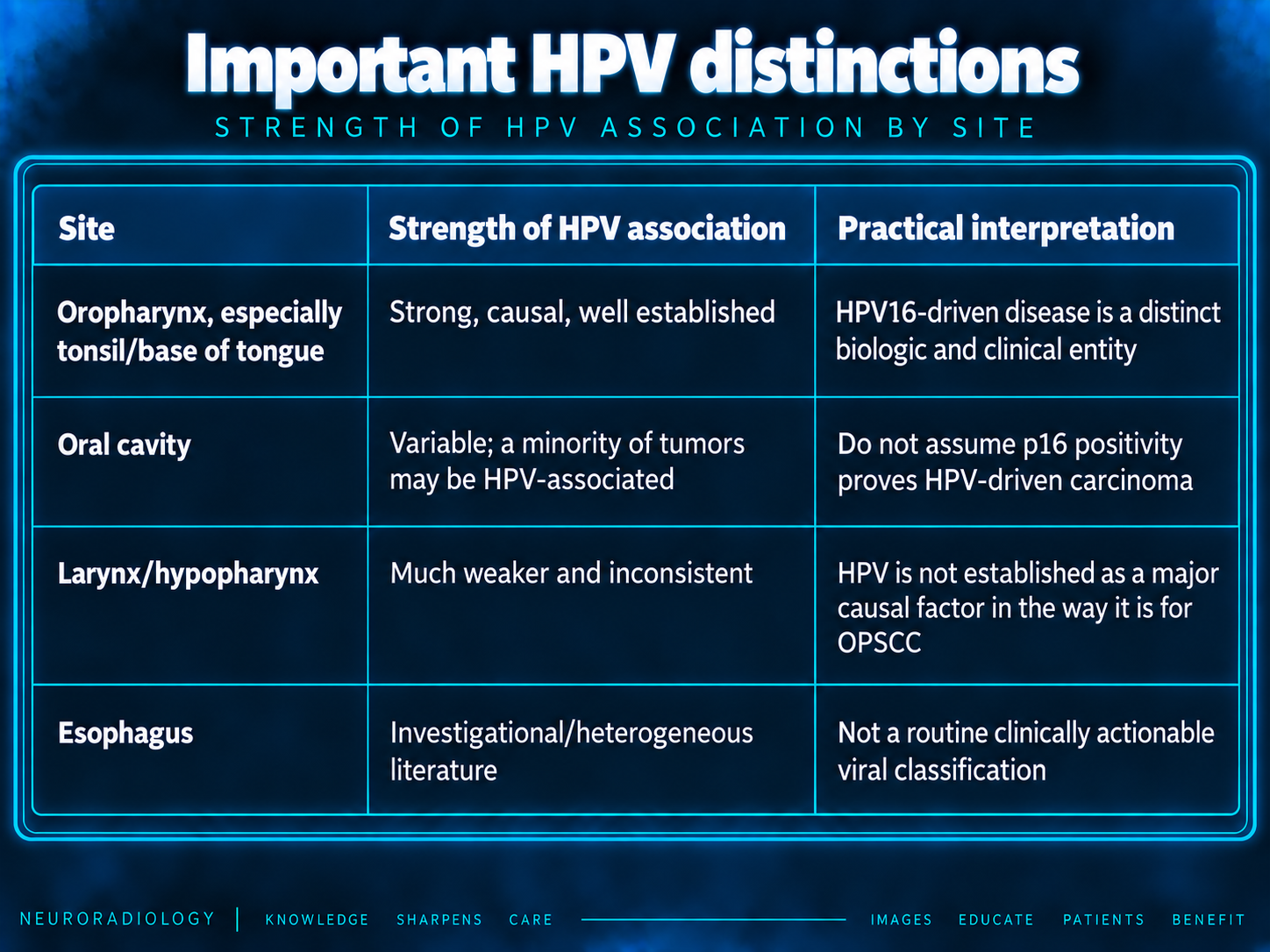
Important HPV distinctions
| Site | Strength of HPV association | Practical interpretation |
|---|---|---|
| Oropharynx, especially tonsil/base of tongue | Strong, causal, well established | HPV16-driven disease is a distinct biologic and clinical entity |
| Oral cavity | Variable; a minority of tumors may be HPV-associated | Do not assume p16 positivity proves HPV-driven carcinoma |
| Larynx/hypopharynx | Much weaker and inconsistent | HPV is not established as a major causal factor in the way it is for OPSCC |
| Esophagus | Investigational/heterogeneous literature | Not a routine clinically actionable viral classification |
The supplied content attributes to CDC the statement that HPV is implicated in oropharyngeal cancer and is not known to cause several other head-and-neck cancer types, including laryngeal cancer. [cdc; source URL not supplied]
EBV: established in nasopharyngeal carcinoma
EBV has a robust and central etiologic relationship with NPC, particularly the nonkeratinizing differentiated and undifferentiated types prevalent in endemic regions such as southern China, Southeast Asia, North Africa, and certain Arctic Indigenous populations. [idrc-crdi; source URL not supplied]
Keep the tumor categories distinct
- HPV-related tumor: usually oropharyngeal SCC, especially tonsil/base of tongue.
- EBV-related tumor: nasopharyngeal carcinoma, often nonkeratinizing rather than conventional keratinizing SCC.
- Tobacco/alcohol-related tumor: more commonly conventional HPV-negative SCC across oral cavity, larynx, hypopharynx, and portions of the oropharynx.
Plasma EBV DNA
In NPC, plasma EBV DNA is clinically useful for screening in selected high-risk populations, prognostication, treatment response assessment, and surveillance in many oncologic settings, reflecting the strong biologic link between EBV and the disease.
EBV outside the nasopharynx
EBV DNA or EBV-related signals have been reported in some oral cavity and other head-and-neck SCC studies, and some reports describe HPV/EBV co-detection. Detection of viral nucleic acid or protein in a tumor does not by itself establish etiologic causation.
Why the evidence is heterogeneous
- Geographic variation in tumor populations and viral prevalence
- Different assay methods and thresholds
- Potential viral signal from infiltrating lymphocytes rather than malignant epithelial cells
- Inconsistent confirmation of viral transcriptional activity
- Confounding from tobacco, alcohol, nutrition, host genetics, and other exposures
Small observational cohorts may find HPV and EBV in upper-aerodigestive SCC specimens, but these results should be interpreted as associations rather than proof that EBV independently drives conventional SCC throughout the tract.
Source limitations
The supplied prose includes citation labels “cdc” and “idrc-crdi” without complete references or URLs. The additional graphic-specific claims noted above require source review before use as independently referenced quantitative statements.