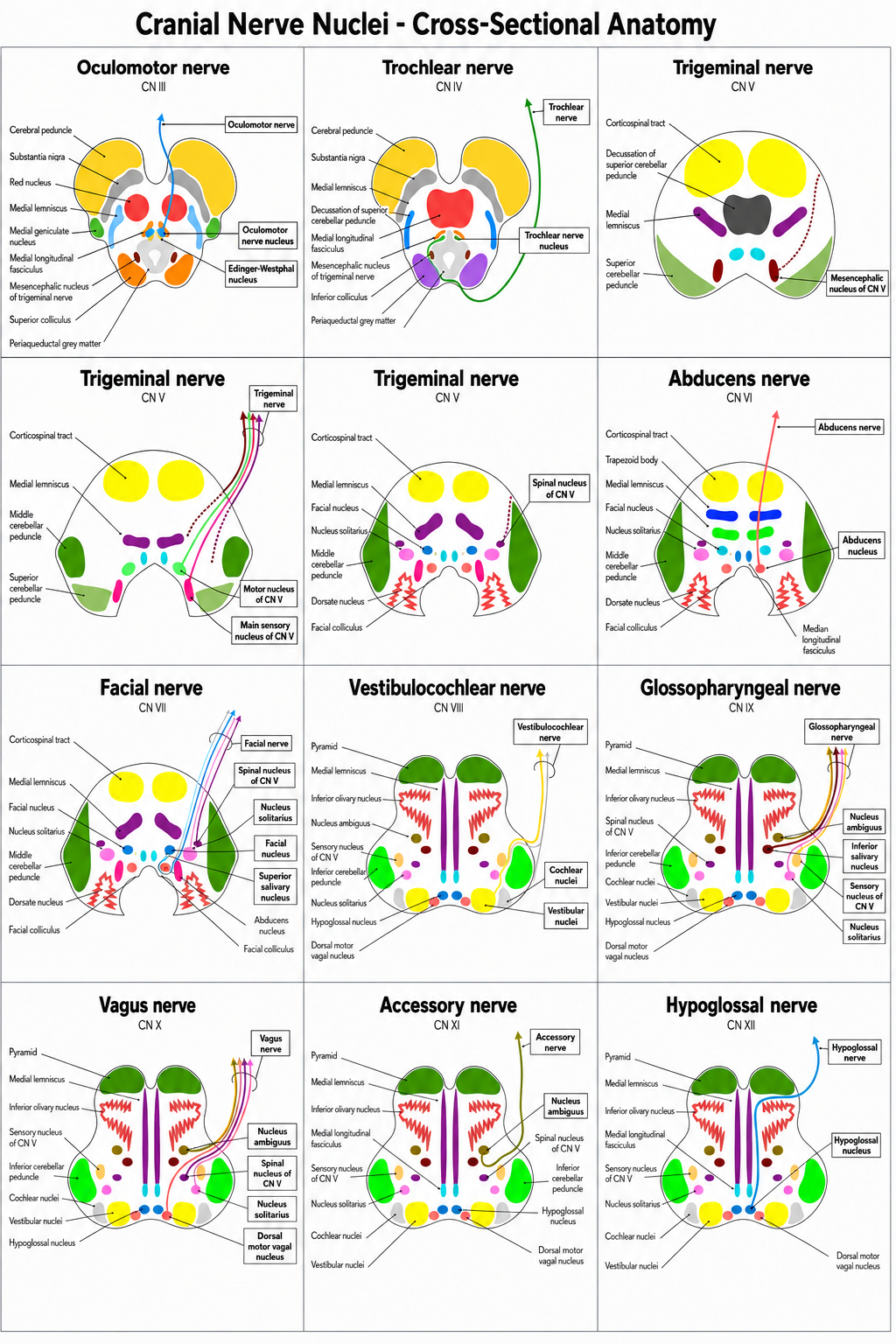
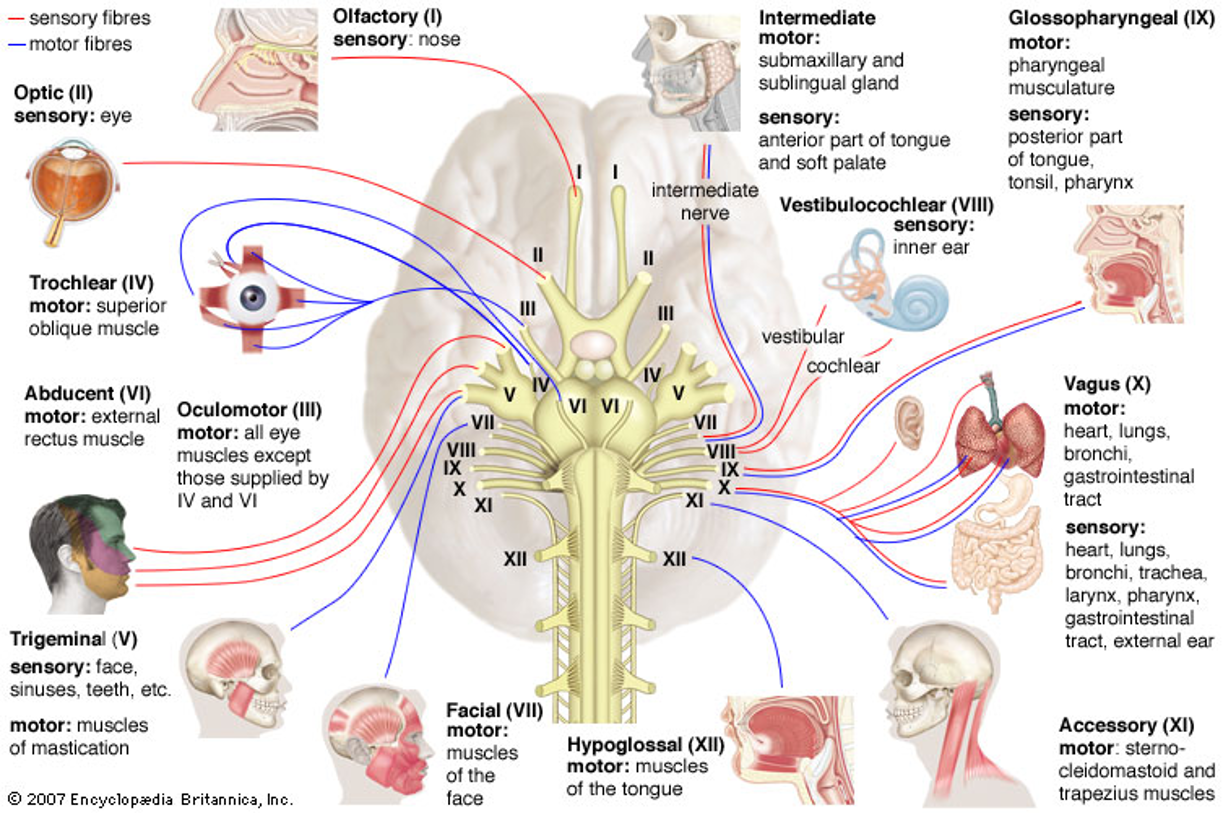
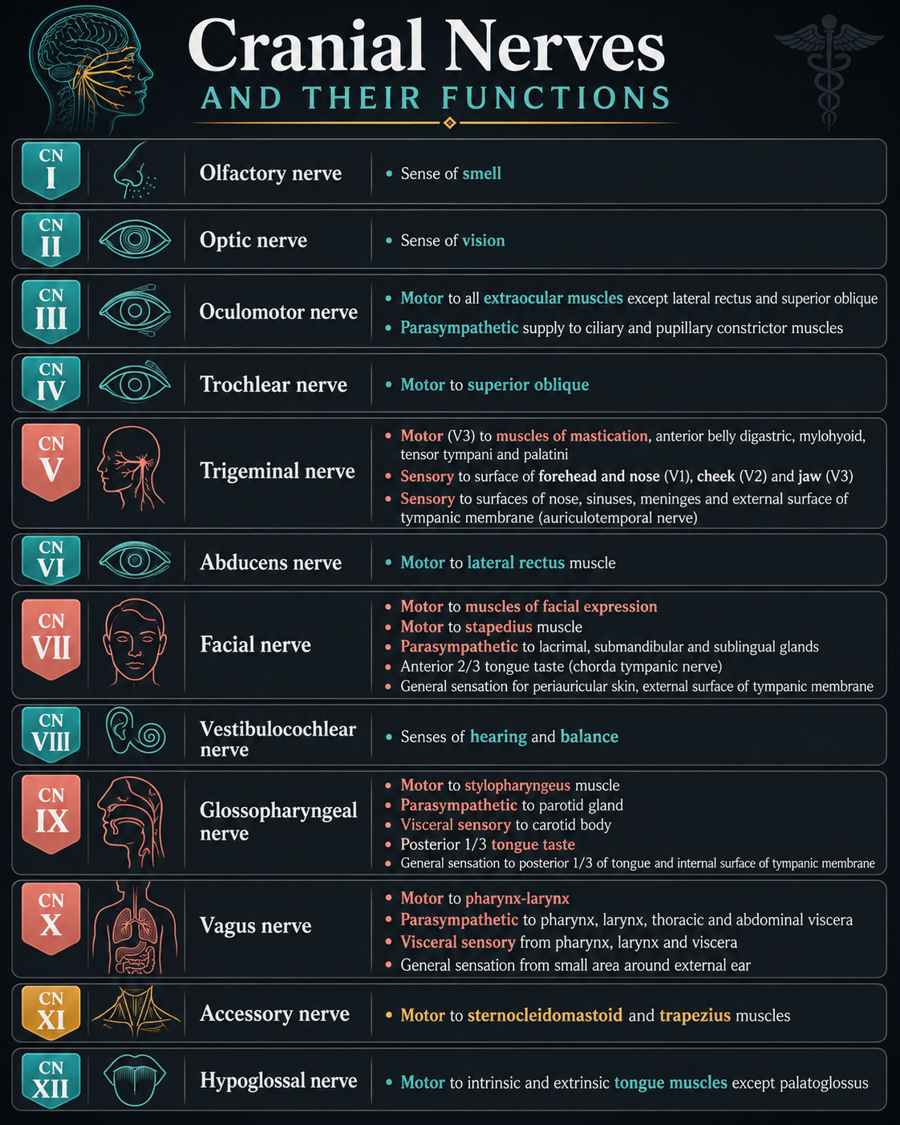
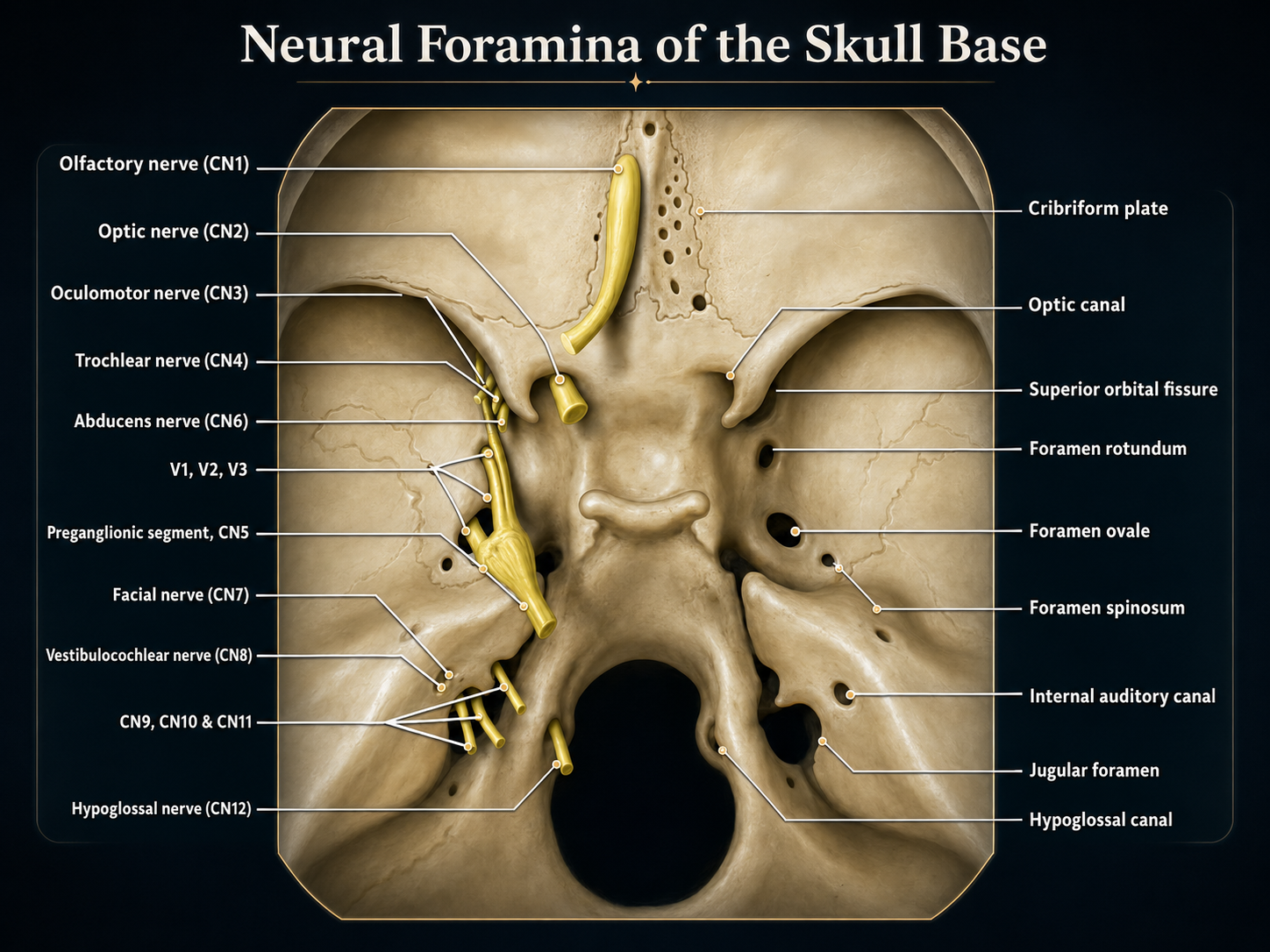
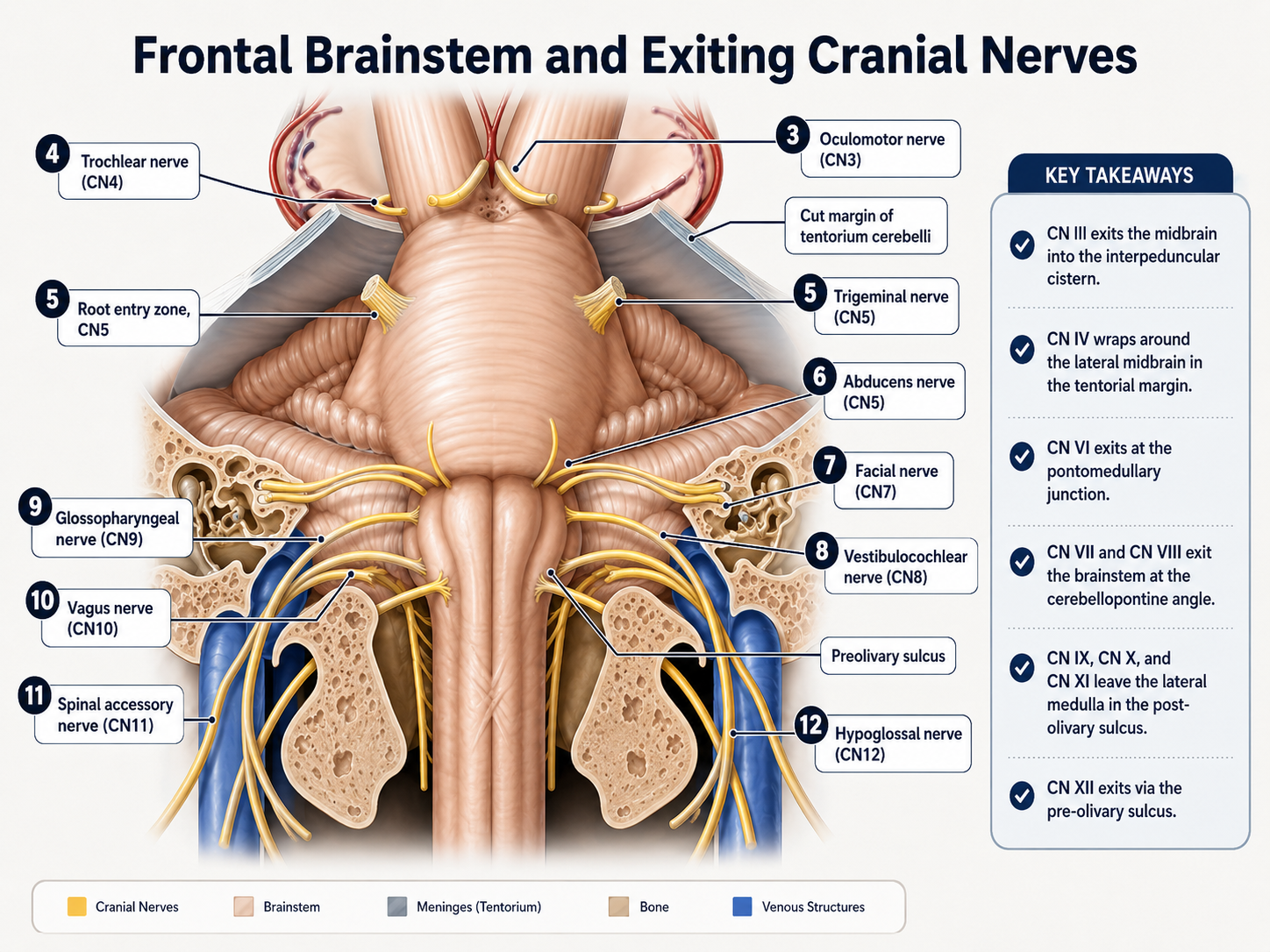
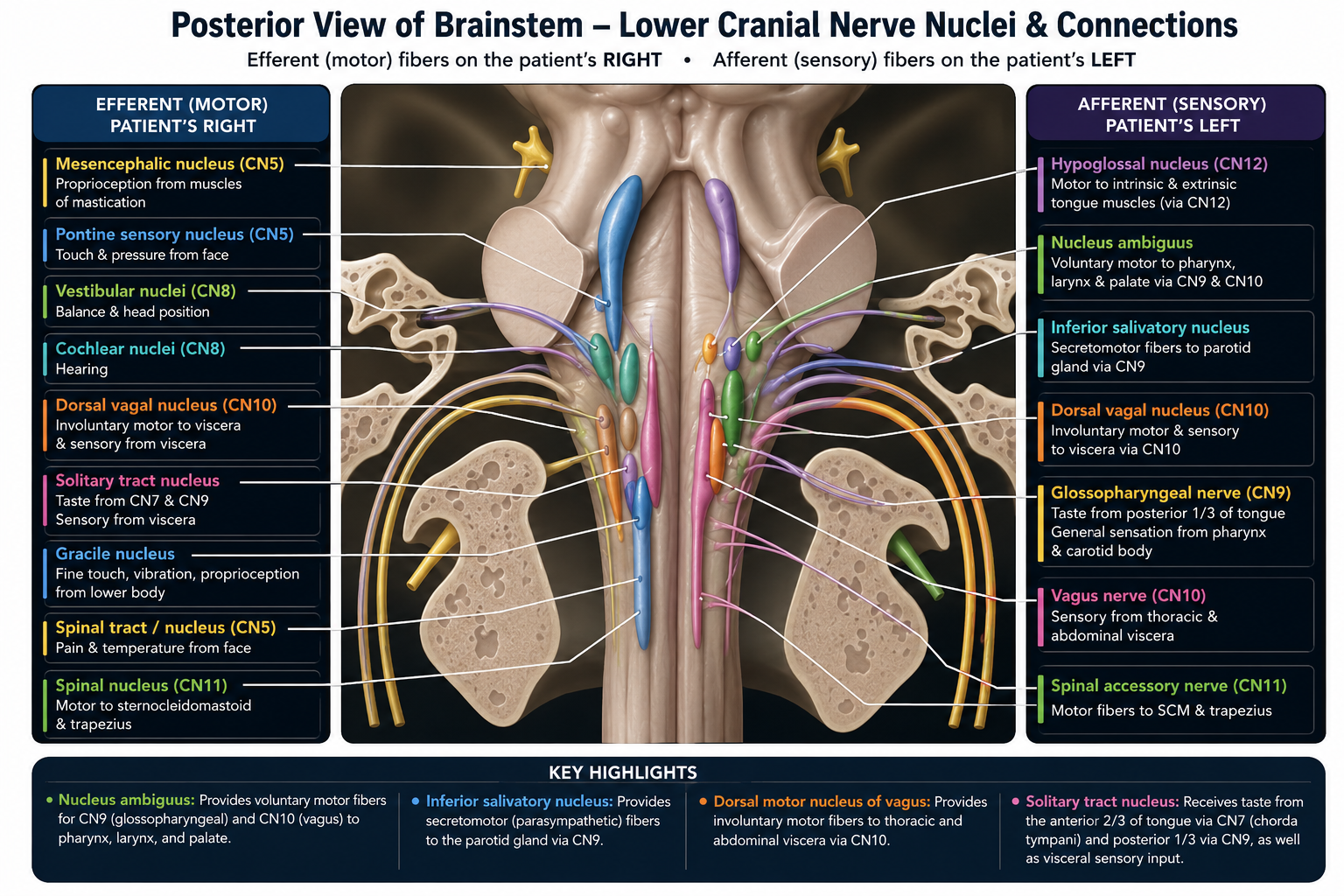
Modalities · nuclei · brainstem exits · skull-base foramina · examination · localization
CN I · SVAOlfactory
Function & course
Smell; receptor axons cross the cribriform plate to bulb, tract, and primary olfactory cortex.
Examine
Test each nostril with a recognizable non-irritating odor.
Localize
Anosmia: sinonasal disease, cribriform trauma, olfactory-groove lesion, or neurodegeneration.
CN II · SSAOptic
Function & course
Retina → nerve → chiasm → tract → LGN → radiations → occipital cortex; afferent light-reflex limb.
Examine
Acuity, color, fields, pupils/RAPD, and fundus.
Localize
Chiasm: bitemporal loss. Retrochiasmal: homonymous defect.
CN III · Motor + PSOculomotor
Function
Levator, SR, IR, MR, IO; Edinger–Westphal parasympathetics constrict pupil and accommodate.
Examine
Ptosis, pupils, ductions, accommodation.
Localize
Complete palsy: ptosis, “down and out,” ± mydriasis. Painful pupil involvement requires urgent aneurysm evaluation.
CN IV · MotorTrochlear
Function
Superior oblique: depresses the adducted eye and intorts. Exits dorsally and decussates.
Examine
Depression in adduction; vertical/torsional diplopia and head tilt.
Localize
Nuclear lesion affects contralateral SO; nerve lesion affects ipsilateral SO.
CN V · MixedTrigeminal
Function
V1/V2/V3 facial sensation; V3 motor to mastication and related muscles. V1 is corneal-reflex afferent limb.
Examine
V1–V3 sensation, masseter/temporalis, jaw opening, corneal reflex when indicated.
Localize
Meckel cave, cavernous sinus, peripheral divisions, or brainstem; jaw deviates toward weak V3 side.
CN VI · MotorAbducens
Function
Lateral rectus abduction; nucleus also drives horizontal conjugate gaze.
Examine
Abduction and horizontal diplopia by gaze direction.
Localize
Nerve palsy causes ipsilateral abduction deficit; nuclear lesion causes ipsilateral horizontal-gaze palsy.
CN VII · MixedFacial
Function
Facial expression, stapedius; anterior 2/3 taste; lacrimal and submandibular/sublingual secretion. Corneal-reflex efferent limb.
Examine
Brow raise, eye closure, smile, cheek puff.
Localize
Peripheral palsy affects forehead and lower face; supranuclear palsy usually spares forehead.
CN VIII · SSAVestibulocochlear
Function
Cochlear hearing and vestibular head-motion, position, and balance signals; travels with VII in the IAC.
Examine
Hearing, Weber/Rinne, nystagmus, head impulse, gait, positional symptoms.
Localize
Combined VII/VIII findings suggest CPA or IAC pathology.
CN IX · MixedGlossopharyngeal
Function
Posterior 1/3 taste/sensation, pharynx, carotid sinus/body; stylopharyngeus; parotid secretion. Gag afferent limb.
Examine
Voice, swallow, palatal/pharyngeal sensation selectively.
Localize
Isolated IX palsy is uncommon; IX–XI combination suggests jugular-foramen disease.
CN X · MixedVagus
Function
Motor to palate/pharynx/larynx; visceral sensory and parasympathetic supply to thoracoabdominal viscera. Gag efferent limb.
Examine
Voice, swallow/aspiration, palatal elevation, cough; laryngoscopy when needed.
Localize
Palate droops and uvula deviates away; consider medulla, jugular foramen, carotid space, or recurrent laryngeal course.
CN XI · MotorSpinal Accessory
Function & course
Upper cervical spinal roots ascend via foramen magnum and exit the jugular foramen to SCM and trapezius.
Examine
Shoulder shrug and head rotation against resistance.
Localize
Weak shrug/shoulder droop; weak SCM impairs turning toward the opposite side. Vulnerable in posterior-triangle surgery.
CN XII · MotorHypoglossal
Function
Intrinsic and extrinsic tongue muscles except palatoglossus; exits hypoglossal canal.
Examine
Atrophy, fasciculations, protrusion, movement, articulation, and oral-phase swallowing.
Localize
LMN lesion: tongue deviates toward lesion with ipsilateral atrophy/fasciculations.